Bio
Thao Anh Nguyen is a multidisciplinary artist and architect from Hanoi, Vietnam. She is currently based in Providence, RI, USA. She is pursuing a degree in Painting and Interior Architecture at Rhode Island School of Design, with a minor in the Belief track of History, Philosophy, and the Social Sciences. Her interest lies in the socio-political discourse that encompasses her experience of belonging to both the dominant (Kinh) and minor (Tay) ethnic groups in Vietnam.
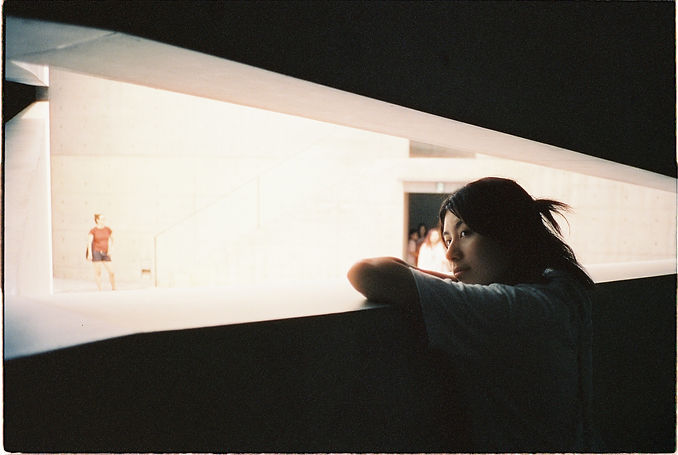
Her practice recontextualizes spiritual materials and rituals to question what it means to be animated. She explores unstable boundaries between human and animal, land and organism, and natural body and cyborg, asking who decides what counts as alive and in what sense. She understands animacy as a political condition as much as a metaphysical one, with the capacity to disrupt binaries such as life and death, subject and object, and speech and nonspeech. Through this lens, she considers whether land and nature can possess animacy of their own, with value equivalent to human life.
Her paintings draw from research into Vietnamese shamanism, particularly its allegories, materials, and performances, as well as from philosophical and political frameworks including Mel Y. Chen’s writing on animacy, Michel Foucault’s concept of heterotopia, and Giorgio Agamben’s notion of bare life. Traditional Vietnamese performance forms such as Hát bội, Hát Tuồng, and Hát Then inform how she understands belief as something enacted through bodies, gestures, and space rather than fixed doctrine.
Across her work, she approaches space as a layered and multidimensional field rather than a singular or stable viewpoint. Systems such as oblique projection, complex urban circulation, diagrammatic architecture, and contemporary scientific models operate through overlapping events and movements rather than linear resolution. This approach frames space as something that unfolds through time, action, and perception, emphasizing how spatial structures organize bodies, behaviors, and relations rather than simply containing them.
Within this framework, belief emerges through encounters with the limits of perception. Drawing from philosophical discussions of the sublime and architectural precedents that translate abstraction into lived experience, she investigates how material and spatial conditions can stage tension between the measurable and the immeasurable. Rather than treating belief as fixed doctrine, she approaches it as a response to uncertainty, where meaning arises at the threshold between material and immaterial, visibility and obscurity, control and surrender.